


Agentic AI enterprise workflows let autonomous AI agents receive a high‑level business goal and then plan, use tools, and self‑correct until they deliver a result. Instead of waiting for humans to type the next prompt, these workflows orchestrate multiple specialized agents that can coordinate, reason, and act across your systems.
In 2026, this shift from reactive AI to proactive agentic AI enterprise workflows is one of the biggest changes in enterprise software. This article explains how agentic systems work, where they deliver the most value, and what it takes to build them safely.
What Are Agentic AI Enterprise Workflows?
A standard LLM responds to one prompt and stops. An AI agent does three additional things:
- Planning — breaks a complex goal into a sequence of sub‑tasks.
- Tool use — calls external tools (web search, code execution, database queries, APIs) to gather real‑world information.
- Self‑correction — evaluates its own output, detects errors, and retries with a revised approach.
When multiple agents work in parallel — each specializing in a different task — this is called a multi‑agent system or agentic AI enterprise workflow.
For the foundational context on AI system architecture, see:
AI & Machine Learning Development Guide 2026 – Section 8: The Future of AI
For a deeper technical background on the Reason + Act paradigm many agentic AI systems rely on, you can review Google’s overview of the ReAct framework:
ReAct: Synergizing Reasoning and Acting in Language Models
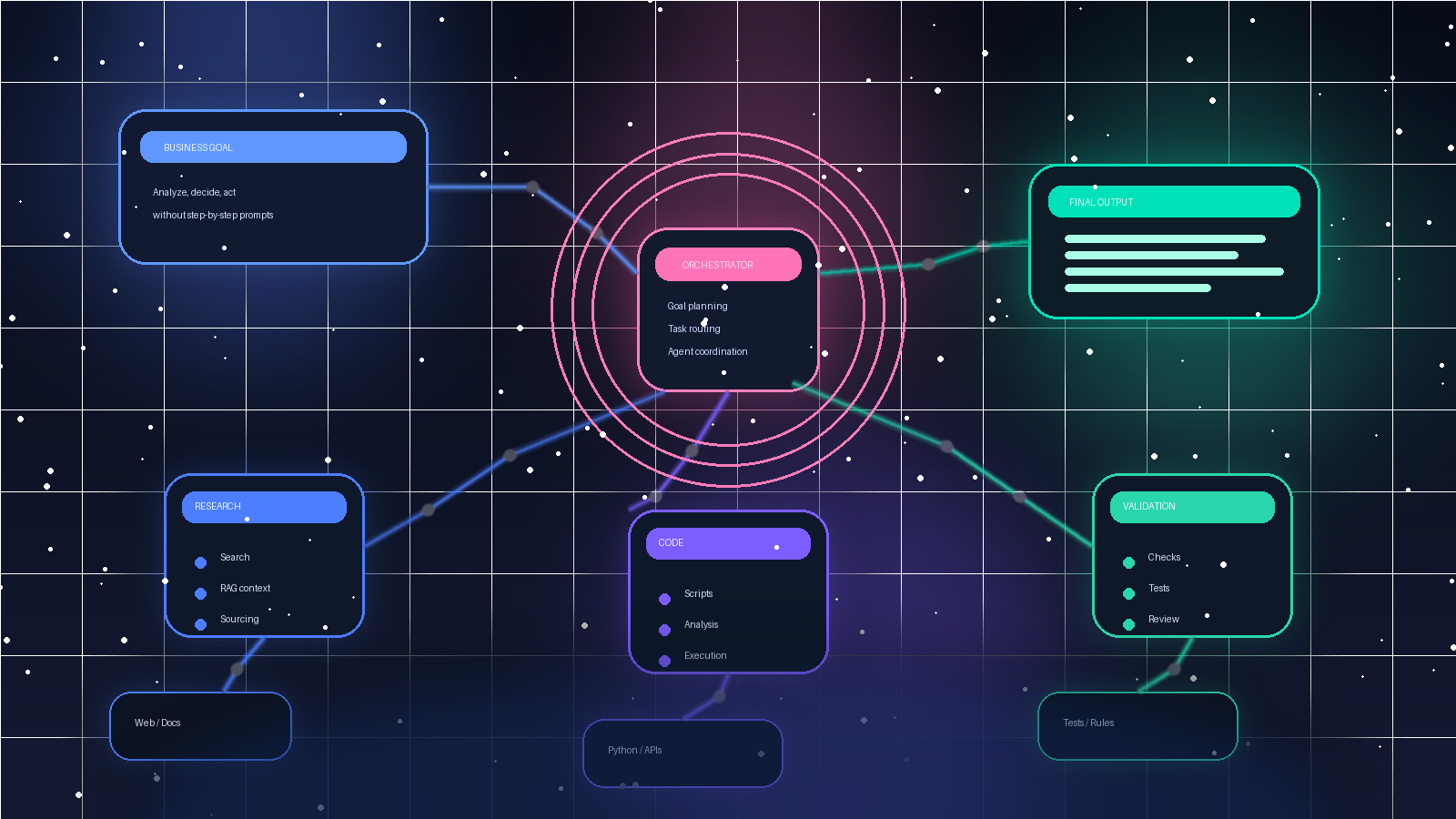
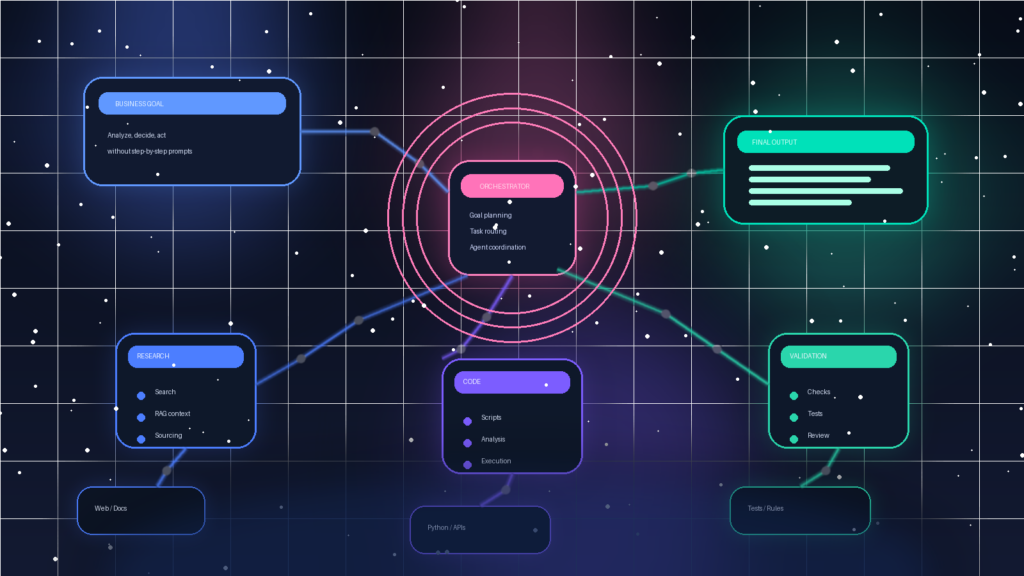
Anatomy of an Agentic AI Enterprise Workflow
A typical enterprise agentic AI workflow has three layers:
1. Orchestrator Agent
Receives the top‑level goal, decomposes it, and delegates sub‑tasks to specialized agents. You can think of it as the project manager of the system.
2. Specialist Agents
Each agent is scoped to a specific capability, for example:
- Research Agent – uses web search and RAG to gather information.
- Code Agent – writes and executes Python scripts to process data.
- Validation Agent – runs tests and checks outputs for correctness.
3. Tool Layer
Agents interact with the real world through tools: APIs, databases, file systems, browsers, and code interpreters. The system converges on a final output only after all agents have completed their tasks and cross‑validated results.
Real Enterprise Use Cases
Agentic AI enterprise workflows are already being deployed across industries:
- Finance: agents that monitor transactions, flag anomalies, generate regulatory reports, and email compliance officers without manual steps in between.
- Software development: coding agents that read a bug ticket, write a fix, run tests, and open a pull request.
- Customer support: orchestrator agents that classify incoming tickets, route them to specialist agents (billing, technical, logistics), retrieve relevant context from a RAG system, and draft responses.
- Supply chain: agents that monitor inventory levels, trigger reorder workflows, update ERP systems, and send vendor notifications autonomously.
The ReAct Framework: How Agents Think
Most production agents are built on the ReAct (Reason + Act) pattern:
- Reason – the agent generates a chain‑of‑thought to plan the next action.
- Act – it executes a tool call (for example search the web, run code).
- Observe – it reads the tool output.
- Repeat – it reasons again based on the new information until the goal is complete.
This loop makes agents significantly more capable than single‑prompt LLMs for complex, multi‑step tasks.
For a deeper technical background on how we got here, see:
AI & Machine Learning Development Guide 2026 – Section 2: The Evolution of Machine Learning
Governance and Safety in Agentic AI Enterprise Workflows
Autonomous agents introduce new risks that do not exist with static LLMs:
- Scope creep – an agent may take actions beyond its intended scope if guardrails are too loose. Define explicit tool permissions per agent.
- Hallucinated tool calls – agents can attempt to call tools that do not exist or with incorrect parameters. Validate all tool schemas strictly.
- Audit trails – every action an agent takes must be logged for compliance under the EU AI Act and GDPR. Design for observability from day one.
- Human‑in‑the‑loop checkpoints – for high‑stakes actions (deleting data, sending emails, processing payments), require human approval before the agent proceeds.
How Yotec Designs Agentic AI Enterprise Workflows
Yotec designs agentic AI enterprise workflows using frameworks such as LangGraph and AutoGen, deployed on Azure or AWS infrastructure. The approach includes:
- Defining strict agent boundaries and tool allowlists.
- Implementing structured logging with full replay capability for audit.
- Using Small Language Models (SLMs) for specialist agents to reduce cost and latency.
- Testing with adversarial inputs before production deployment.
For broader responsible AI practices, see:
AI & Machine Learning Development Guide 2026 – Section 7: Responsible AI Governance
Is Your Organization Ready for Agentic AI?
Agentic AI is not a future technology — it is in production today at many enterprises. The question is not whether to adopt it, but how to do so safely and incrementally.
Start with a narrow, well‑defined workflow where the cost of an error is low and the productivity gain is measurable. Use that pilot to build internal confidence, refine your governance model, and then scale.



About The Author: Yotec Team
More posts by Yotec Team