

GUIDE
AI & Machine Learning Development Guide
Master AI machine learning development: from LLMs to production systems. Complete enterprise guide.
1. Artificial Intelligence in 2026: From Basic Automation to Strategic Innovation
This comprehensive AI and machine learning development guide serves as your roadmap to understanding, implementing, and leveraging artificial intelligence for business growth. Whether you’re exploring AI machine learning development for enterprise systems or building your first ML model, this guide provides practical insights from foundational concepts to production deployment.
🔗 Deep Dive: The AI Coding Trap: Does AI Really Make Developers Faster? — 7 min read
🔗 Developer Tools: GitHub Copilot vs Amazon Codex: A Developer’s Perspective — 8 min read

From the foundational concepts of AI and Machine Learning to real-world applications and ethical considerations, we’ll cover everything you need to know to navigate this exciting domain. Let’s embark on this journey to unlock the full potential of AI and ML together.
For a deeper dive into the fundamental theories of artificial intelligence, refer to the Association for the Advancement of Artificial Intelligence (AAAI) resources.
2. The Evolution of Machine Learning: Building Scalable Enterprise Intelligence
Artificial Intelligence (AI) refers to the simulation of human intelligence in machines that are programmed to think like humans and mimic their actions. The term may also be applied to any machine that exhibits traits associated with a human mind, such as learning and problem-solving.
Key Components of AI
- Machine Learning (ML): A subset of AI that allows systems to learn from data without being explicitly programmed.
- Deep Learning (DL): A subfield of ML that uses neural networks with multiple layers to learn complex patterns from large amounts of data.
- Natural Language Processing (NLP): Enables computers to understand, interpret, and generate human language.
- Computer Vision: Allows machines to “see” and interpret visual information from the world.
- Robotics: Involves the design, construction, operation, and use of robots, often incorporating AI for autonomous functions.
AI machine learning development encompasses multiple disciplines working together to create intelligent systems. The goal of AI is to create systems that can perform tasks that typically require human intelligence, often with greater speed, accuracy, and efficiency.
🔗 Tech Guide: Comparison of ML-as-a-Service Systems (AWS vs Azure vs Google) — 9 min read
3. Machine Learning Architecture: Mastering Data Pipelines and Model Training
Machine Learning (ML) is a subset of artificial intelligence that involves training algorithms to identify patterns in data and make predictions or decisions based on that data, rather than following a set of pre-defined, explicit instructions.
ML algorithms use statistical models to find patterns in massive amounts of data. For most businesses, the journey into AI starts here. Whether it’s predicting customer churn or automating data entry, ML provides the practical tools for innovation. At Yotec, we specialize in AI machine learning development using Python’s robust ecosystem of libraries like Scikit-learn and Pandas, combined with enterprise-grade infrastructure.
How Machines Learn: Supervised vs. Unsupervised
- Supervised Learning: The model is trained on labeled data (e.g., teaching an AI to recognize fraud by showing it examples marked “fraud” or “legit”).
- Unsupervised Learning: The model finds hidden patterns in unlabeled data (perfect for customer segmentation).
- Reinforcement Learning: The model learns through trial and error, receiving “rewards” for correct actions (used in robotics and gaming).
While Python is the leader for data science, enterprise-grade ML systems often require integration with robust backend technologies. In large corporate environments, we frequently implement AI modules within a Java or .NET infrastructure to ensure scalability and security.
🔗 Integration Strategy: When to Implement AI in a Product: Expert Insights from Real-World Use Cases — 10 min read
4. Deep Learning: Neural Networks and Model Architecture
Deep Learning (DL) is a specialized subset of Machine Learning that uses multi-layered neural networks to solve complex problems. It is the technology behind the most impressive AI breakthroughs of the last decade, from self-driving cars to generative models like ChatGPT.
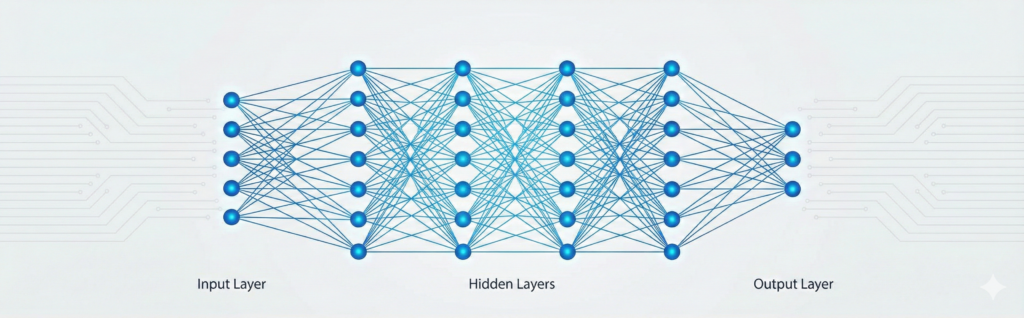
Deep Learning “learns” by passing data through various layers of algorithms, each of which transform the data to define it more clearly. This requires massive amounts of data and significant computing power. For many organizations, building proprietary deep learning models tailored to specific business logic is where true competitive advantage lies.
Expert Insight: When choosing between ML and Deep Learning, consider the “Data-Performance” trade-off. Deep Learning only outperforms traditional ML when you have massive datasets; for smaller, structured datasets, classic Machine Learning is often more cost-effective and easier to audit. When planning your AI machine learning development roadmap, consider the “Data-Performance” trade-off.
How Neural Networks Work
- The Input Layer: Receives raw data such as pixels, text tokens, or numerical values.
- Hidden Layers: Perform complex transformations to identify patterns and features. The “deep” in Deep Learning refers to having many of these layers.
- The Output Layer: Provides the final prediction or decision based on the processed information.
| Feature | Machine Learning | Deep Learning |
|---|---|---|
| Data Requirement | Small to Medium | Massive Datasets |
| Hardware | Standard CPU/GPU | High-end GPUs/TPUs |
| Complexity | Simple to Moderate | High Complexity |
| Feature Engineering | Manual identification | Automatically learned |
| Training Time | Minutes to hours | Days to weeks |
🔗 Expert Insight: Neural Networks and the Reality of Strong AI: The Problem of “Meaning” — 8 min read.
5. NLP and Large Language Models (LLMs)
Natural Language Processing (NLP) is the branch of AI that gives computers the ability to understand, interpret, and generate human language. It bridges the gap between human communication and computer understanding.
Modern NLP has led to the current revolution in Large Language Models (LLMs). These systems can process and generate human-like text at an unprecedented scale, offering new ways to automate customer support, legal analysis, and creative writing.
LLM Strategy: Successful AI machine learning development requires more than “plug and play” public models. To make NLP work for your business safely, focus on RAG (Retrieval-Augmented Generation) to connect LLMs to your private company data without exposing sensitive information to public training sets.
🔗 Strategic Guide: The Whole World is a Model, and LLM is the Backend in it — 10 min read.
🔗 Practical Use: How to Create a Chatbot with Gradio and ChatGPT — 6 min read.
6. Computer Vision Applications: Real-Time Visual Intelligence for Industry 4.0
At Yotec, our AI machine learning development team leverages Python’s powerful libraries like OpenCV and TensorFlow to build custom vision systems. Computer Vision enables computers to identify and process objects in images and videos in the same way that humans do. It involves the automatic extraction, analysis, and understanding of useful information from visual data.

From medical imaging to autonomous vehicles, Computer Vision is providing “eyes” to intelligent systems. At Yotec, we leverage Python’s powerful libraries like OpenCV and TensorFlow to build custom vision systems that can identify defects in manufacturing or analyze medical scans with high precision.
🔗 Industry Focus: Computer Vision for Client Flow Counting and Analytics — 7 min read.
7. Responsible AI Governance: Navigating Ethics, Security, and Global Compliance
As AI becomes more integrated into business processes, building Responsible AI is no longer optional. It involves ensuring that models are fair, transparent, and secure, protecting both the organization and its users from unintended biases or data leaks.
Compliance is increasingly regulated by frameworks like the EU AI Act, which sets the global standard for responsible AI. Ethical AI development focuses on mitigating algorithmic bias and ensuring strict data privacy. For enterprise clients, this means having “explainable AI” – models where decisions can be audited and understood by humans, rather than remaining a “black box.”
Compliance Tip: Always ensure your AI vendors comply with global standards like the EU AI Act or GDPR. At Yotec, we prioritize data anonymization during the training phase to ensure that your proprietary information never leaves your secure environment.
🔗 Ethical View: Ethical Issues in Neural Networks to Consider in Online Business — 8 min read.
8. The Future of AI: Scaling with Autonomous Agents and Agentic Workflows
We are moving from AI that simply “predicts” to AI that “acts.” The future of intelligent systems lies in Agentic Workflows – autonomous agents that can break down complex goals into tasks and execute them across different software environments.
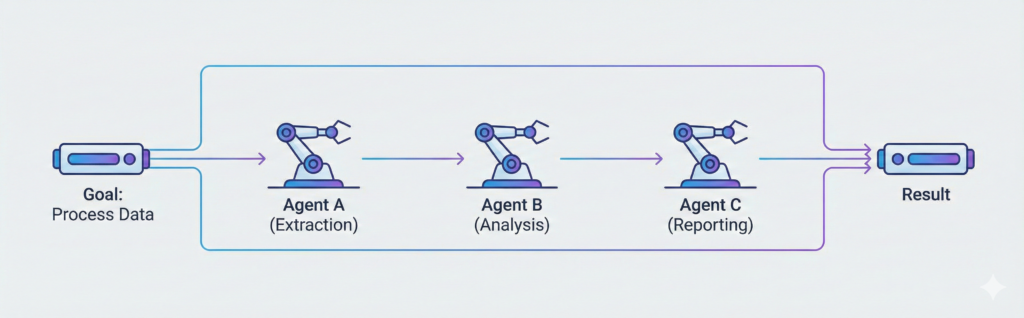
🔗 Technical Deep Dive: Re-Act AI Agent Device: Building Intelligent Autonomous Systems — 9 min read
Another major trend is the rise of Small Language Models (SLMs). Unlike massive models like GPT-4, these are highly specialized for specific industries (like healthcare or law), making them faster, cheaper to run, and more accurate for niche tasks.
9. AI Development: FAQ
Q: How much does it cost to build a custom AI solution? A: Costs vary based on data complexity, but a typical enterprise-grade AI pilot starts between $20k and $50k. The ROI is usually seen within the first 6–12 months through process automation and efficiency gains.
Q: Which programming language is best for AI? A: Python is the gold standard for model development. However, for high-performance integration, we often use Java or .NET backends.
🔗 Technical Deep Dive: Java Development for Enterprise AI: Best Practices and Architecture — 7 min read.
Q: Is my company data safe when using LLMs? A: Yes, provided you use Private LLM instances (via Azure or AWS) or RAG architectures. Public models like the free version of ChatGPT should never be used for sensitive corporate data.
10. Conclusion: Starting Your AI Journey
Successful AI machine learning development is a journey that starts with a clear understanding of your data and business goals. This guide has covered the fundamental pillars—from the basics of Machine Learning to the complexities of Deep Learning and Ethics.
Ready to transform your business with intelligent software? Whether you need a custom ML model or a full-scale LLM integration, our team is here to help you navigate the complexity.
🔗 Contact Yotec today to discuss your AI roadmap.