

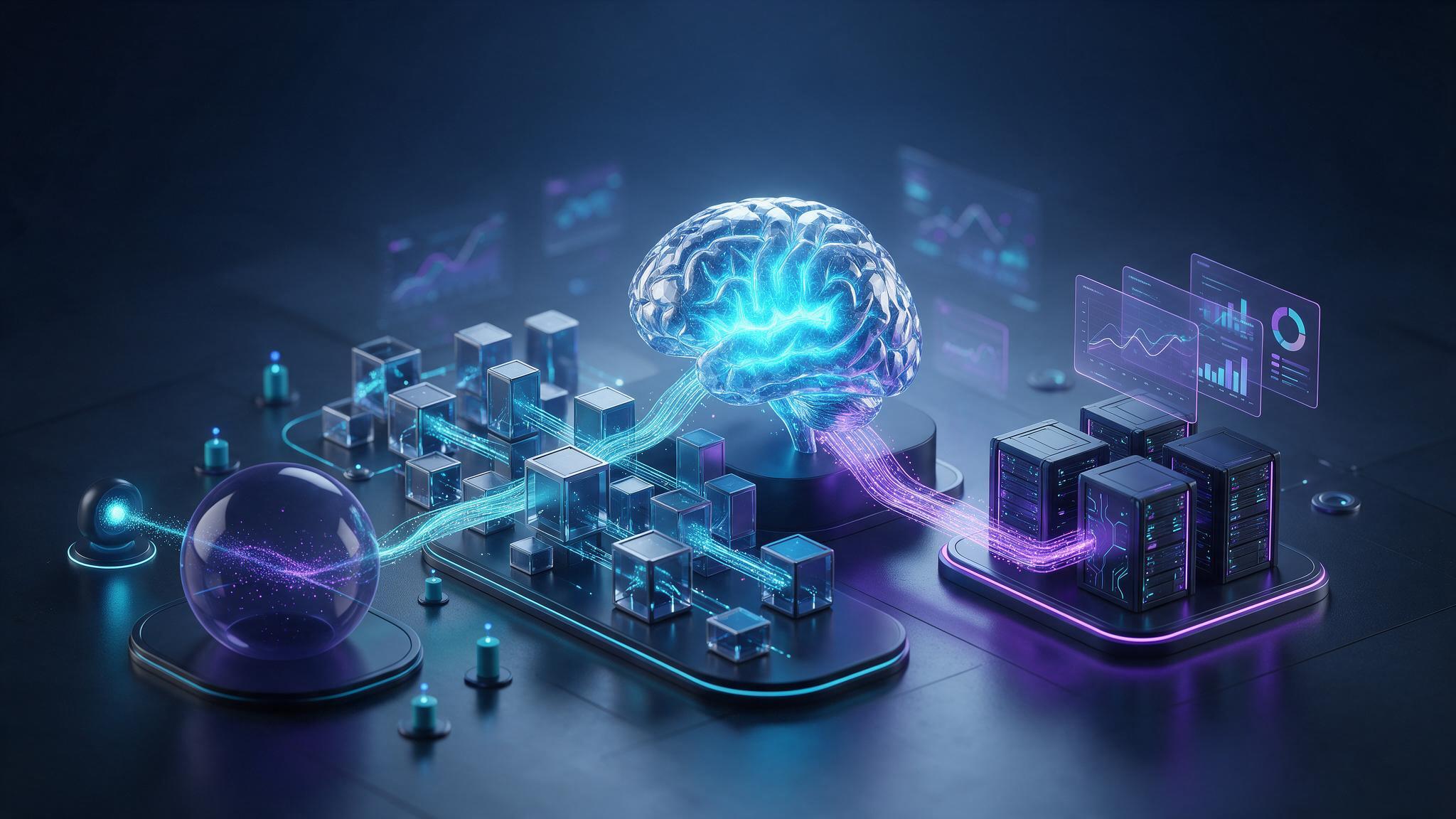

Many organizations successfully build machine learning models in a lab environment, but struggle to deploy them securely into production. Enterprise MLOps architecture bridges this gap. It provides the structured processes, automated pipelines, and monitoring tools required to take AI from an isolated pilot to a reliable business system.
In 2026, as AI systems become more complex and business-critical, a robust enterprise MLOps architecture is no longer optional—it is the foundation of scalable AI.
What is Enterprise MLOps Architecture?
MLOps (Machine Learning Operations) is the intersection of machine learning, DevOps, and data engineering. An enterprise MLOps architecture standardizes how data scientists and IT operations teams collaborate to manage the entire AI lifecycle.
This lifecycle includes data ingestion, model training, version control, API deployment, and continuous monitoring. Without these automated pipelines, models quickly degrade in accuracy and become impossible to maintain.
For a broader overview of how machine learning systems are structured, see our complete guide:
AI & Machine Learning Development Guide 2026 – Section 3: Machine Learning Architecture
For external best practices on scaling these systems, the Google Cloud MLOps framework provides an excellent technical baseline for continuous delivery in machine learning.
The Core Pillars of Enterprise MLOps Architecture
A modern enterprise MLOps architecture relies on several interconnected components to keep AI systems running smoothly:
1. Automated Data Pipelines
Before a model can learn, it needs high-quality data. Automated pipelines ensure that data is continuously extracted, cleaned, and transformed into a format the model can consume. Feature stores are often used here to allow different teams to reuse data features without rewriting code.
2. Model Registry and Version Control
Just as software developers use Git to track code changes, data scientists use a model registry to track AI models. A registry stores the model artifacts, the exact data it was trained on, and its performance metrics. If a newly deployed model underperforms, the registry allows the team to instantly roll back to a previous, stable version.
3. Continuous Integration and Deployment (CI/CD)
In an enterprise MLOps architecture, deploying a model shouldn’t require manual server configurations. CI/CD pipelines automatically test the model for accuracy and bias, package it into a secure container (like Docker), and deploy it to a staging or production environment.
4. Continuous Monitoring and Retraining
The real world changes constantly, and models lose accuracy over time—a concept known as “data drift.” Production architecture must include monitoring tools that track the model’s predictions in real-time. If performance drops below a certain threshold, the system automatically alerts the team or triggers a retraining pipeline using fresh data.
Why Scalable MLOps Matters in 2026
Building a single AI tool is relatively easy; managing fifty of them across an enterprise is incredibly difficult. Investing in your enterprise MLOps architecture delivers three critical benefits:
- Speed to Market: Automated deployment pipelines reduce the time it takes to launch a model from months to days.
- Reliability and Security: Containerized deployments and strict version control prevent system crashes and ensure compliance with IT security standards.
- Cost Efficiency: Monitoring tools help optimize expensive cloud compute resources (like GPUs) by scaling them up during peak demand and spinning them down when idle.
How Yotec Builds Enterprise MLOps Architecture
At Yotec, we design enterprise MLOps architecture tailored to your specific cloud environment—whether that is AWS, Azure, or Google Cloud. We implement robust CI/CD pipelines, set up secure model registries using tools like MLflow or Vertex AI, and build the monitoring dashboards your operations team needs to maintain oversight.
If your team is struggling to move AI models out of the lab and into reliable production, standardizing your MLOps is the next vital step.
Contact Yotec today to discuss scaling your AI infrastructure.


About The Author: Yotec Team
More posts by Yotec Team