
LLM fine-tuning is the process of training an existing large language model on your own examples so it learns your terminology, tone, and task logic. It is one of three main ways to customize an LLM for business, alongside prompt engineering and Retrieval-Augmented Generation (RAG). Choosing the wrong method wastes budget. Choosing the right one, however, turns a generic chatbot into a reliable enterprise tool.
In this guide, we explain how LLM fine-tuning works, when it beats RAG, and how to run a fine-tuning project safely in 2026.
This article is part of our AI & Machine Learning Development Guide 2026 – Section 5: NLP and Large Language Models.
Key Takeaways
- Fine-tuning changes behavior, RAG adds knowledge. Fine-tune to teach a model how to respond; use RAG to give it what to respond with.
- Start simple. Most teams should try prompt engineering first, then RAG, and only then fine-tuning.
- Parameter-efficient methods cut costs. Techniques such as LoRA and QLoRA train a small set of extra weights instead of the whole model.
- Data quality matters more than volume. A few thousand clean, reviewed examples often outperform a large, noisy dataset.
- Hybrid wins in production. Many enterprise systems combine a fine-tuned model with a RAG pipeline.
What Is LLM Fine-Tuning?
A foundation model, such as Llama, Mistral, or GPT, is pre-trained on a huge public dataset. As a result, it knows a lot about the world but very little about your business. Fine-tuning continues the training process on a smaller, task-specific dataset. Consequently, the model adjusts its internal weights to match your examples.
In practice, LLM fine-tuning teaches a model to:
- Follow a strict output format, such as JSON for an internal API.
- Use domain language correctly, for example legal, medical, or insurance terms.
- Write in a consistent brand voice across thousands of responses.
- Perform a narrow task, like ticket classification or contract clause extraction, with higher accuracy.
Fine-tuning is a form of transfer learning. If you want to understand the neural network layers that are being adjusted, see Section 4 of our guide: Deep Learning and Neural Networks.
LLM Fine-Tuning vs RAG vs Prompt Engineering
All three methods customize a model, but they solve different problems. The table below compares them side by side.
| Criteria | Prompt Engineering | RAG | Fine-Tuning |
|---|---|---|---|
| What it changes | The instructions | The context the model sees | The model weights |
| Best for | Quick prototypes | Fresh or private knowledge | Style, format, and specialized tasks |
| Data needed | A few examples | A document collection | Hundreds to thousands of labeled pairs |
| Upfront cost | Very low | Medium | Medium to high |
| Keeps knowledge current | No | Yes | No, retraining required |
| Source citations | No | Yes | No |
| Inference cost | Higher (long prompts) | Higher (retrieved context) | Lower (short prompts) |
In short, RAG answers the question “what does the model know?”, while fine-tuning answers “how does the model behave?”. We cover the retrieval approach in detail in RAG for Enterprise LLM: How to Connect LLMs to Private Business Data Safely.
When LLM Fine-Tuning Is the Right Choice
Fine-tuning pays off when the problem is about behavior, not facts. Consider it when:
- Prompts become too long. If you need pages of instructions and examples in every request, fine-tuning can move that logic into the model. This reduces latency and token costs.
- Output must be highly consistent. Regulated reports, structured data extraction, and automated workflows cannot tolerate format drift.
- The domain language is unusual. General models often misuse niche terminology in fields like pharmaceuticals, logistics, or engineering.
- You want a smaller, cheaper model. A fine-tuned small model can match a large general model on one narrow task. We discuss this trend in Enterprise Agentic AI and Small Language Models.
- The model must run on-premises. Fine-tuning an open-weight model lets you deploy it fully inside your own infrastructure.
When RAG Is the Better Option
On the other hand, fine-tuning is a poor tool for teaching facts. A fine-tuned model may still invent details, and it cannot show where an answer came from. Choose RAG instead when:
- Your knowledge base changes weekly or daily, such as prices, policies, or product specs.
- Users need answers with links to source documents.
- Access rights differ by user, so each person should only see permitted documents.
- You have documents but no labeled question-and-answer examples.
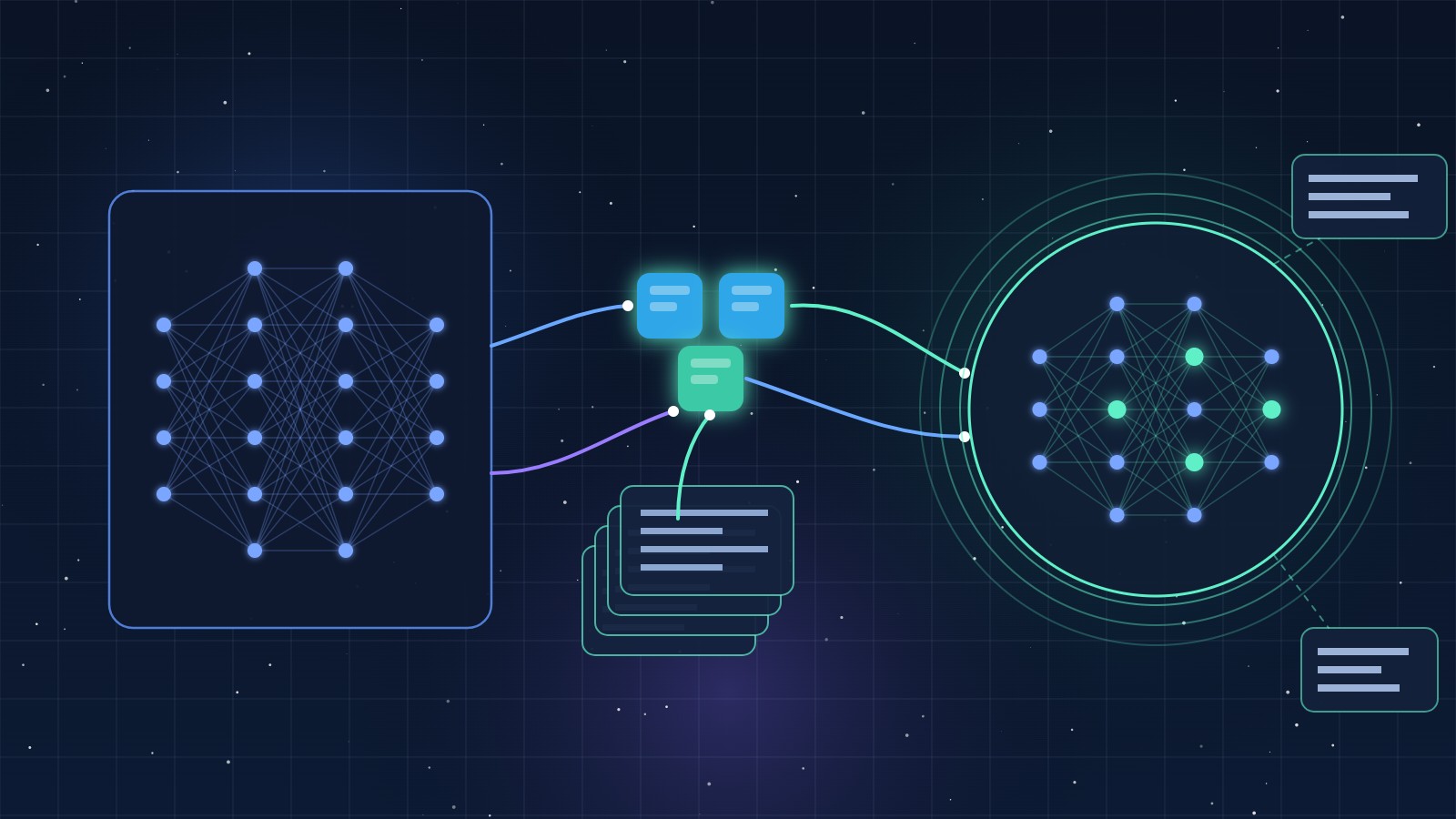
How LLM Fine-Tuning Works: Full vs Parameter-Efficient Methods
Not every fine-tuning project retrains the entire model. Today, teams usually choose between three approaches.
Full Fine-Tuning
Full fine-tuning updates every weight in the model. It can deliver the best accuracy for a single task. However, it requires large GPU clusters, produces a full copy of the model for each use case, and increases the risk of “catastrophic forgetting”, where the model loses general skills.
LoRA and QLoRA
Parameter-efficient fine-tuning (PEFT) freezes the original model and trains a small set of additional weights. The most popular technique is LoRA (Low-Rank Adaptation). According to its authors, LoRA can reduce the number of trainable parameters by up to 10,000 times compared with full fine-tuning of GPT-3.
QLoRA goes further by loading the base model in 4-bit precision. As a result, even very large models can be adapted on a single high-memory GPU. For teams getting started, the open-source Hugging Face PEFT library is a practical starting point.
For enterprises, the biggest advantage is modularity. Each LoRA adapter is only a few megabytes, so one base model can serve many departments with different adapters.
Instruction Tuning and Preference Alignment
Supervised instruction tuning trains the model on prompt-and-response pairs. After that, preference methods such as DPO (Direct Preference Optimization) teach the model which of two answers people prefer. This second step is useful for tone, helpfulness, and safety rules.
A 6-Step Enterprise Fine-Tuning Roadmap
A successful project follows a clear, repeatable process:
- Define the task and success metric. For example, “extract 12 fields from supplier invoices with 98% accuracy”.
- Build a baseline. First, test prompt engineering and RAG. If they meet the target, you may not need fine-tuning at all.
- Prepare the dataset. Collect, clean, anonymize, and review examples. Then split them into training, validation, and test sets.
- Select the base model. Balance accuracy, license terms, model size, and hosting options.
- Train and evaluate. Run LoRA or QLoRA experiments and compare them against the baseline on the held-out test set. Also check that general skills have not degraded.
- Deploy and monitor. Version the model, track quality in production, and schedule retraining when data drifts.
Steps 5 and 6 rely on solid MLOps practices. Our article Enterprise MLOps Architecture: Scaling AI in 2026 explains how to automate them.
Security, Compliance, and Cost Considerations
Training data becomes part of the model. Therefore, never include personal data, secrets, or confidential records unless they are properly anonymized. A fine-tuned model can reveal fragments of its training data when prompted in a specific way.
In addition, regulations such as the EU AI Act require documentation of training data and model behavior for many use cases. Keep a clear record of data sources, versions, and evaluation results. Our Responsible AI Governance guide covers these requirements in more detail.
When it comes to cost, compute for a LoRA run is often modest. The larger costs are usually data preparation, expert review, and evaluation. Plan your budget accordingly.
The Hybrid Approach: Combining Fine-Tuning and RAG
In production, the strongest systems often use both methods. A fine-tuned model handles format, tone, and domain reasoning. Meanwhile, a RAG pipeline supplies current, permission-filtered facts with citations. For example, a customer support assistant may be fine-tuned on approved past replies and connected via RAG to the latest product documentation.
How Yotec Delivers LLM Fine-Tuning Projects
At Yotec, we help companies decide whether LLM fine-tuning, RAG, or a hybrid architecture best fits their goals. Our team prepares and anonymizes training datasets, runs LoRA and QLoRA experiments on open-weight models, and deploys the results on AWS, Azure, Google Cloud, or your own servers. We also integrate the models into existing Java, .NET, and Python systems.
Not sure which approach suits your use case? Contact Yotec to discuss your LLM customization project.
Frequently Asked Questions About LLM Fine-Tuning
LLM fine-tuning changes the model weights so it behaves differently, for example by following a fixed format or using domain terminology. RAG leaves the model unchanged and instead retrieves relevant documents at query time, so answers stay current and can cite sources.
For parameter-efficient methods like LoRA, a few hundred to a few thousand high-quality, reviewed examples are often enough for a narrow task. Clean and consistent data matters more than raw volume.
A focused enterprise project usually takes several weeks. Most of that time goes into defining the task, preparing data, and evaluating results. The training run itself often takes only hours with LoRA or QLoRA.
Both are possible. Several commercial providers offer managed fine-tuning APIs, while open-weight models such as Llama or Mistral can be fine-tuned and hosted entirely in your own infrastructure for maximum data control.
It can be, if the data is anonymized and training happens in a secure environment you control. Because a model can memorize parts of its training data, personal data and secrets should be removed before training.

About The Author: Yotec Team
More posts by Yotec Team