LLM inference optimization is the practice of making a trained large language model answer faster and at lower cost in production, without an unacceptable loss in quality. In other words, it is the engineering work that happens after you pick a model and before you pay the monthly GPU or API bill. For many enterprise AI products, inference is the cost that keeps growing, because every new user and every longer prompt adds to it.
This article is part of our AI & Machine Learning Development Guide 2026 – Section 4: Deep Learning: Neural Networks and Model Architecture.

Key Takeaways
- Measure before you optimize. Track latency, throughput and cost per request on your real traffic first.
- Most waste is in memory, not math. Text generation is usually limited by GPU memory bandwidth and the KV cache.
- Start with serving, then compress. A modern serving engine with continuous batching is often the cheapest first win.
- Quantize with an evaluation gate. Lower precision saves memory, but you must re-test quality on your own tasks.
- Route and cache. Send simple requests to smaller models and reuse answers or prompt prefixes where you can.
What Is LLM Inference Optimization and Why Does It Matter in 2026?
Training a model is a one-time project. Inference, however, runs every time a user asks a question. As a result, a successful AI assistant can cost far more to serve than it ever cost to build.
Optimization targets three numbers. The first is latency, meaning how long a user waits for the first token and for the full answer. The second is throughput, meaning how many requests or tokens one server handles per second. The third is cost per request, which follows from the first two. Good LLM inference optimization moves all three in the right direction at once.
It also connects to the rest of your stack. For example, a RAG system sends long prompts full of retrieved documents, so its inference profile differs from a short chatbot. Likewise, the agents described in our article on enterprise agentic AI and small language models call a model many times per task. Therefore, every saved millisecond multiplies.
Where Inference Time and Money Actually Go
An LLM produces an answer in two phases. During prefill, the model reads the whole prompt in parallel. During decode, it then generates the answer one token at a time. Prefill is mostly limited by raw compute. Decode, in contrast, is usually limited by how fast the GPU can move model weights and cached data through memory.
The key data structure is the KV cache. It stores attention keys and values for every token already processed, so the model does not recompute them. Unfortunately, the cache grows with prompt length and with the number of parallel users. Consequently, memory, not arithmetic, often decides how many requests fit on one GPU.
This explains why the most effective techniques shrink the model, manage memory better or avoid work entirely. Next, let us look at each one.
Core LLM Inference Optimization Techniques
Quantization: Smaller Numbers, Smaller Bills
Quantization stores model weights, and sometimes activations, in fewer bits. For instance, a model trained in 16-bit precision can often run in 8-bit or 4-bit form. Fewer bits mean less memory per weight, so a larger model fits on fewer GPUs and decoding moves less data.
Post-training methods make this practical without retraining. The GPTQ paper showed that very large GPT-style models can be quantized to 3 or 4 bits per weight with only small accuracy loss on the benchmarks it tested. Still, results vary by model and task. So treat quantization as a hypothesis and confirm it with your own test set.
Continuous Batching and a Paged KV Cache
Naive serving handles requests one by one or in fixed batches. As a result, the GPU waits for the slowest request in each batch. Continuous batching, instead, adds new requests to the running batch as soon as earlier ones finish.
Memory management matters just as much. The PagedAttention paper behind vLLM stores the KV cache in small pages, similar to virtual memory in an operating system. Its authors report a 2–4× throughput improvement over the serving systems they compared, at similar latency. For most teams, therefore, switching to a modern serving engine is the first and simplest step.
Speculative Decoding
Speculative decoding uses a small, fast draft model to propose several tokens. The large model then checks them in one pass and keeps the ones it agrees with. According to the original speculative decoding paper, this approach produced 2–3× faster generation in its experiments without changing the output distribution. It works best when the draft model guesses well, for example on predictable, structured text.
Caching and Model Routing
The cheapest token is the one you never generate. Prefix caching reuses the processed system prompt or shared documents across requests. Meanwhile, response caching returns a stored answer when the same question arrives again. Model routing goes further: a lightweight classifier sends simple requests to a small model and only hard ones to the largest model.
Distillation and Smaller Models
Distillation trains a smaller student model to imitate a larger teacher on your tasks. It takes more effort than quantization, and it overlaps with the trade-offs in our guide to LLM fine-tuning vs. RAG. However, for a narrow, high-volume task, a distilled model can be much cheaper to serve than a general one.
Comparing LLM Inference Optimization Techniques
The table below summarizes when each technique fits. Effort and risk are relative and depend on your model and stack.
| Technique | Main benefit | Quality risk | Effort | Best fit |
|---|---|---|---|---|
| Modern serving engine (continuous batching, paged KV cache) | Higher throughput per GPU | Very low | Low | Any self-hosted model |
| Quantization (8-bit / 4-bit) | Less memory, fewer GPUs | Low to medium | Low to medium | Large models on limited hardware |
| Speculative decoding | Lower latency per answer | Very low | Medium | Latency-sensitive chat and code |
| Prefix and response caching | Skips repeated work | Low | Low | Shared system prompts, repeated questions |
| Model routing | Cheaper average request | Medium | Medium | Mixed easy and hard traffic |
| Distillation | Small, task-specific model | Medium | High | Narrow, high-volume tasks |
A 6-Step LLM Inference Optimization Plan for Enterprise Teams
A clear sequence prevents teams from compressing a model before they know where the time goes. We recommend the following order.
- Set targets. First, agree on acceptable time to first token, total latency and cost per request for each use case.
- Profile real traffic. Next, log prompt lengths, output lengths and concurrency. Synthetic tests often hide the real bottleneck.
- Upgrade the serving layer. Then move to an engine with continuous batching, a paged KV cache and prefix caching.
- Build an evaluation gate. Before any compression, create a task-specific test set, as described in our LLM evaluation guide.
- Compress and route. After that, try quantization, speculative decoding and routing one at a time, and keep only changes that pass the gate.
- Monitor in production. Finally, track latency, cost and quality drift on dashboards, and roll back quickly when a metric slips.
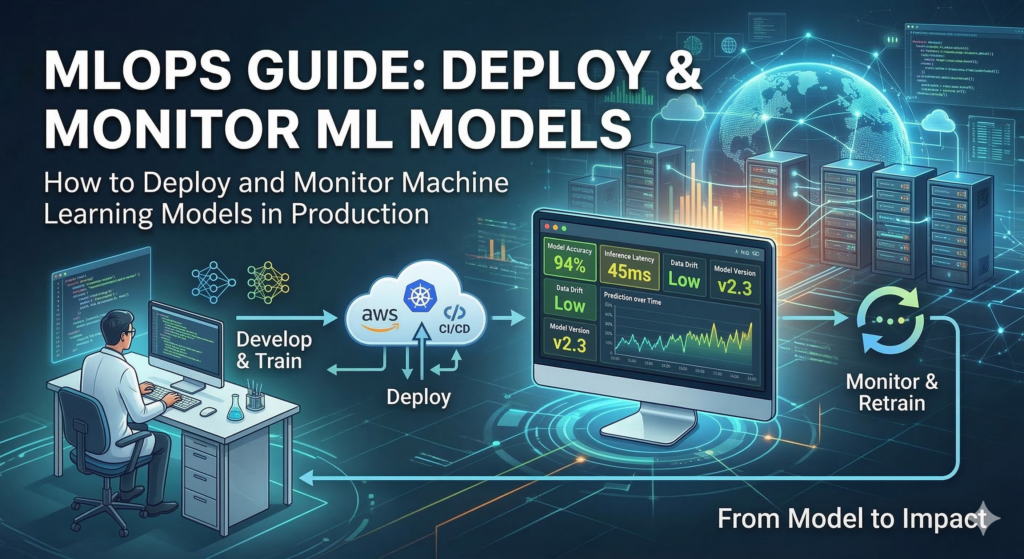
Step six is where inference meets MLOps. Our MLOps guide to deploying and monitoring models and the article on enterprise MLOps architecture cover the monitoring and rollout side in detail.
Common Mistakes to Avoid
- Optimizing on benchmarks only. Public benchmarks rarely match your prompts, so always confirm gains on your own data.
- Ignoring prompt length. Long system prompts and oversized RAG context raise cost on every call. Trimming them is often free.
- Stacking changes at once. If you quantize, change the engine and switch models together, you cannot tell which change hurt quality.
- Forgetting the tail. Average latency can look fine while the slowest requests frustrate users. Track high percentiles too.
How Yotec Helps With LLM Inference Optimization
Yotec builds and operates enterprise AI systems, from the first prototype to production. Our engineers profile your workloads, choose the right serving stack and set up evaluation gates, so cost savings never come at the expense of answer quality. We also connect inference metrics to your existing monitoring and cloud setup. To see how this fits the wider picture, read the deep learning section of our AI guide or browse our AI/ML and LLM solutions.
Is your AI feature getting slower or more expensive as usage grows? Contact Yotec to discuss an inference review for your models.
Frequently Asked Questions About LLM Inference Optimization
LLM inference optimization is the set of techniques that make a trained language model respond faster and cheaper in production. Typical methods include modern serving engines, quantization, speculative decoding, caching and model routing.
It can, but the loss is often small at 8-bit precision and sometimes acceptable at 4-bit. The impact depends on the model and the task, so always compare quantized and original models on your own test set before switching.
For self-hosted models, moving to a serving engine with continuous batching and a paged KV cache is usually the simplest first step. For API-based models, trimming prompts, caching repeated requests and routing simple tasks to smaller models often help most.
Yes, when implemented correctly. The large model verifies every token the draft model proposes, so the method is designed to keep the same output distribution. The main risk is low speed gain when the draft model guesses poorly.
Compare latency, throughput and cost per request before and after each change, using real traffic. At the same time, run your evaluation set to confirm that quality stayed within the agreed limits.