RAG for enterprise LLM is the most practical way to make large language models work with your private business data while keeping that data secure and compliant. Large Language Models like GPT‑4 are powerful — but they know nothing about your company. Your internal reports, client contracts, product documentation, and support history are invisible to them. Retrieval‑Augmented Generation (RAG) solves this by letting you connect any LLM to your private data without uploading sensitive files to a public model.
This guide explains how RAG works, when to use it, and how Yotec implements it for enterprise clients.
What Is RAG for Enterprise LLM and Why Does It Matter?
RAG is an AI architecture that combines two systems: a document retrieval engine and a language model. Instead of relying solely on what a model was trained on, RAG first searches your private knowledge base for relevant context, then passes that context to the LLM to generate a grounded, accurate answer.
For a broader introduction to Retrieval‑Augmented Generation in general (not specific to enterprise use cases), see this overview from OpenAI’s ecosystem partners:
External introduction to RAG
This approach is the industry‑standard solution for building internal AI assistants — from HR knowledge bots to legal document analyzers — without leaking sensitive data to public training sets.
For the full AI and machine learning context, see our complete guide:
AI & Machine Learning Development Guide 2026 – Section 5: NLP and Large Language Models (LLMs)
The 3‑Layer RAG Architecture for Enterprise LLM
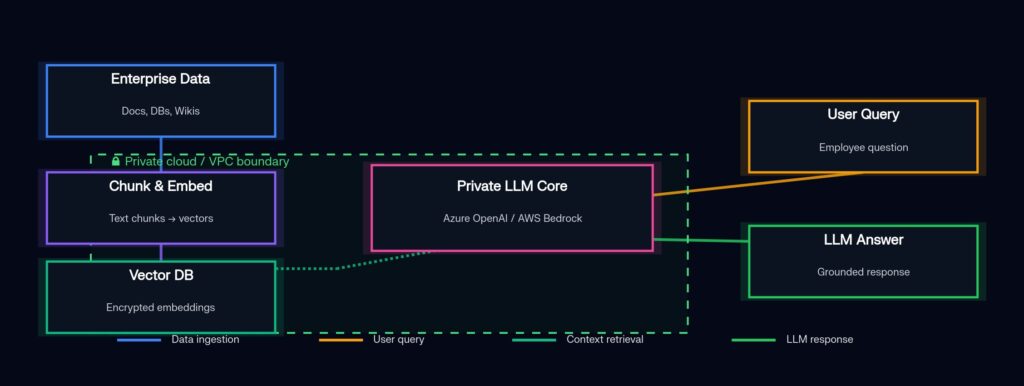
A production RAG for enterprise LLM setup operates in three distinct layers:
1. Data Layer
- Your raw documents (PDFs, databases, tickets, wiki pages) are split into chunks.
- Each chunk is converted into a numerical vector (embedding) and stored in a Vector Database (for example Pinecone, Weaviate, or pgvector on PostgreSQL).
2. Retrieval Layer
- When a user submits a query, it is also converted into an embedding.
- The system performs a semantic similarity search in the vector database to find the most relevant chunks.
3. Query Layer
- The retrieved chunks are injected as context into the LLM prompt.
- The LLM generates a response grounded in your private data — not in public internet knowledge.
RAG vs. Fine‑Tuning: Which Should You Choose?
Many enterprises ask whether they should fine‑tune a model or use RAG. The answer depends on your use case:
| Factor | RAG | Fine‑Tuning |
|---|---|---|
| Data freshness | Real‑time (always updated) | Static (requires retraining) |
| Cost | Low (inference only) | High (GPU training) |
| Data privacy | Data stays in your DB | Data used in training |
| Best for | Internal Q&A, search | Tone/style customization |
For most enterprise use cases where data changes frequently — such as product catalogs, support tickets, or compliance documents — RAG is the better and cheaper choice.
How Yotec Builds RAG for Enterprise LLM Systems
At Yotec, we implement RAG pipelines using:
- LangChain or LlamaIndex as the orchestration framework
- Azure OpenAI or AWS Bedrock for private LLM instances (no data sent to public endpoints)
- PostgreSQL with pgvector for cost‑effective vector storage in enterprise environments
- Python for the entire data pipeline — ingestion, chunking, embedding, retrieval
We typically deploy within a client’s existing cloud infrastructure (Azure or AWS) to ensure full data residency compliance with GDPR and the EU AI Act.
For architecture patterns including Java and .NET backends, see:
AI & Machine Learning Development Guide 2026 – Section 3: Machine Learning Architecture
Key Security Considerations
- Always use private LLM endpoints (Azure OpenAI Service or AWS Bedrock) — never the public ChatGPT UI for corporate data.
- Apply role‑based access control (RBAC) at the vector database level so users only retrieve documents they are authorized to see.
- Log all queries and retrievals for compliance auditing.
- Regularly re‑index your vector database as documents change — stale embeddings produce incorrect answers.
Getting Started
If your team is asking “how do we make our AI assistant actually know our business?”, RAG for enterprise LLM is the answer. It is the most cost‑effective, secure, and production‑proven approach for enterprise LLM integration in 2026.